I have helped a lot of friends get into electronics. The official "learn electronics" path mostly does not work. Six months of theoretical Ohm's Law before you build anything is a great way to lose all motivation.
Here is the path that actually works for people starting from zero. Tested on dozens of friends. Adjusted over years.
Phase 1: Build something in your first weekend (Days 1-3)
The most important thing on day one is to build something that works. Theory comes later. Motivation comes from making things light up.
What to do:
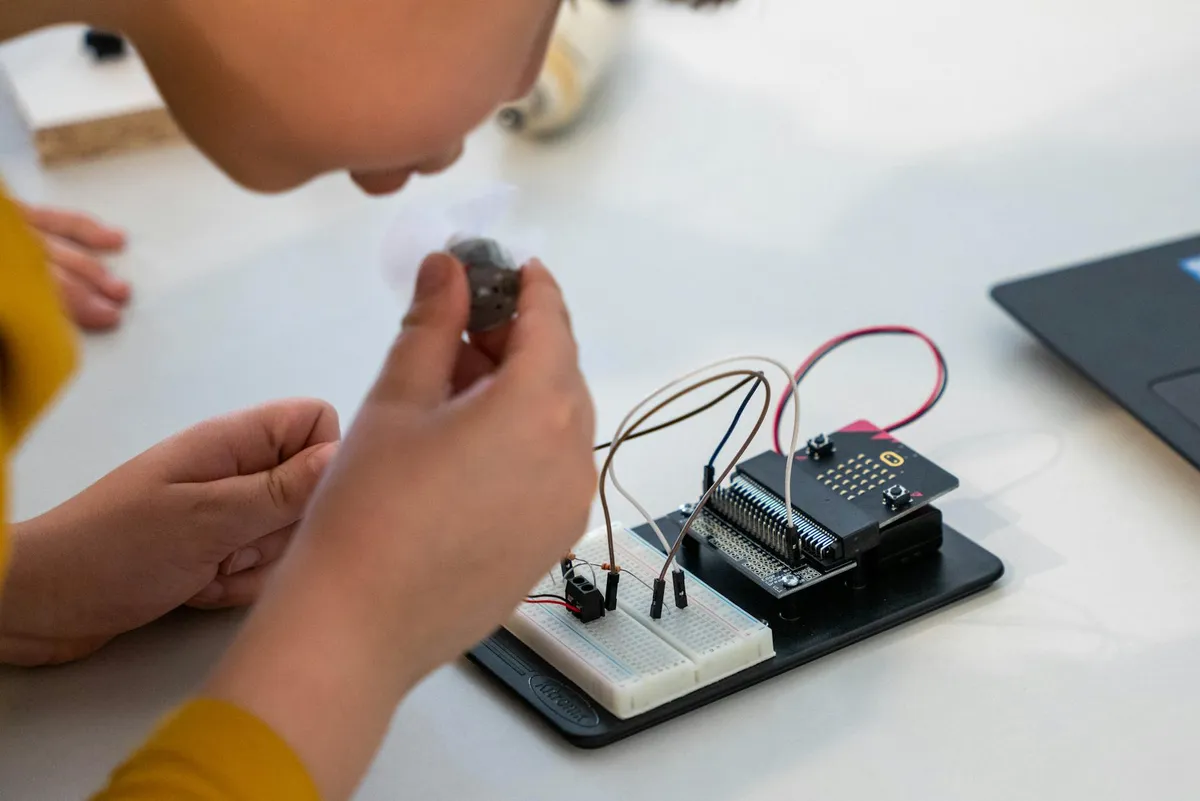
- Buy an ESP32 board ($10) and a small kit with LEDs, resistors, jumper wires, and a breadboard ($20).
- Watch one 20-minute YouTube tutorial on "Arduino IDE setup with ESP32."
- Make an LED blink. Then change the timing. Then add another LED.
- Make a small variation that is YOUR variation, not exactly the tutorial.
What you have learned: The basic toolchain. How to upload code. How to wire something simple. The dopamine of "I made that work."
Time invested: About 4-6 hours.
Phase 2: Learn enough theory to be dangerous (Week 1-2)
Now you have built something. The motivation is real. Some theory will help you avoid frying components.
What to learn:
- Voltage, current, resistance: Just enough to understand "why I need a resistor with the LED" and "why the wrong voltage destroys things."
- Series vs parallel: When wires are connected what way.
- Common voltage levels: 3.3V, 5V, why they matter.
- Reading a basic schematic: Symbols for resistors, capacitors, LEDs, microcontroller pins.
How to learn it: Practical Electronics for Inventors by Scherz and Monk is the right book if you want a book. Otherwise, just watch GreatScott! or Andreas Spiess YouTube videos as they come up in your project work.
What NOT to do: Do not try to learn all of electrical engineering theory before building things. You will burn out.
Phase 3: Build a project that does something real (Week 3-4)
Now you have basics. Time to build something useful.
Pick from:
- A motion-activated light
- A simple weather station with a small display
- An IoT button that triggers something on your computer
- A music-reactive LED strip
What you will learn: Sensors, displays, basic networking, integrating multiple components into a working project.
Time investment: About 8-12 hours, including learning new libraries and debugging.
What to expect: Things will break. You will spend hours figuring out why something does not work. This is the actual work of electronics. Embrace it.
Phase 4: Learn soldering (Month 2)
Once you can do breadboard projects reliably, learn to solder. This unlocks permanent projects and a much wider range of components.
What to do:
- Buy a decent soldering iron with adjustable temperature ($60-100). Do not buy the $15 one.
- Buy practice solder kits ($15) — they have you solder LEDs onto a board to practice.
- Watch one good tutorial. Eevblog's soldering tutorial is the canonical one.
- Practice for 2-3 hours until your joints look reasonably clean.
- Move on to a real project that requires soldering.
What you will learn: Soldering technique, surface mount basics (eventually), component identification.
Common pitfall: The cheap soldering iron will make you hate soldering. The good one will make you love it. Spend the money.
Phase 5: Learn debugging (Month 3+)
Most of being good at electronics is being good at debugging. The path to debugging mastery is by encountering many problems.
Tools to acquire as you encounter their needs:
- Multimeter: Get this early. ($30)
- Logic analyzer: When you start working with I2C/SPI sensors. ($30)
- Bench power supply: When prototyping battery-powered projects. ($90)
Mental skills to develop:
- Reading data sheets (start by skimming, gradually get more thorough)
- Systematic isolation (changing one thing at a time when debugging)
- Thinking in terms of signals rather than just code
- Questioning assumptions when things do not work
Phase 6: Pick a specialty (Month 4+)
By now you have basic skills across many areas. Time to go deeper in something specific.
Common specialties to consider:
- Home automation/IoT: Building things connected to your home network. Lots of practical projects.
- Robotics: Motors, sensors, autonomous behavior. More mechanical than pure electronics.
- Audio: DSP, synthesizers, amplifiers. Specific skill set.
- RF/wireless: Radios, antennas, signal processing. Steeper learning curve.
- Power electronics: Battery management, charging circuits, motor control.
Each specialty has its own ecosystem of components, tools, and knowledge. Pick what interests you.
The mistakes most beginners make
Patterns I see consistently:
1. Buying everything before knowing what they need. The "ultimate beginner kit" usually sits in the box. Buy as you encounter specific needs.
2. Learning too much theory before building anything. Theory makes more sense after you have practical context.
3. Not soldering anything. Breadboard-only work limits you substantially. Soldering opens up most projects.
4. Avoiding debugging. Debugging IS electronics. The skill is learned through encountering problems.
5. Watching too many tutorials, building too few projects. Tutorial consumption is comforting but does not produce skill. Building projects does.
The community part
Connecting with other makers helps:
- Hackaday: Project documentation site. Browse for inspiration.
- Reddit r/electronics, r/arduino, r/esp32: Active help communities.
- Local maker spaces: Many cities have shared workshops. Worth visiting.
- YouTube channels: GreatScott!, Andreas Spiess, EEVblog, Andrew Klofas.
- Discord servers: Many specific to platforms (ESP32, Pi, etc.).
The long view
Electronics is one of those skills that compounds beautifully over years. After 1 year of consistent practice, you can build basic projects. After 3 years, you can build serious projects. After 10 years, you have substantial expertise.
The hours spent compound. The skills accumulate. The projects get more interesting as you can do more.
Most people do not make it past the first frustration point. The ones who do find that electronics becomes one of the more rewarding hobbies available.
The takeaway
Stop reading about electronics and build something this weekend. The path above is tested. The motivation comes from making things actually work, not from theoretical preparation.
Buy an ESP32 and a basic kit today. Make an LED blink by Sunday. Then build something useful next weekend. Within a month, you will be solving real problems with electronics.